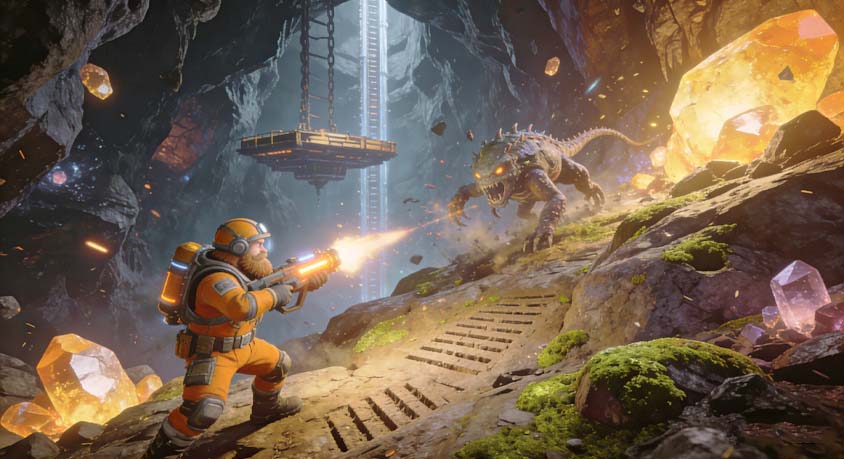
Most co-op games treat teamwork like a suggestion—something you “should” do if you’re feeling nice, but totally optional if you want to go lone wolf. Deep Rock Galactic? It laughs at that idea, then welds teamwork into every drill, grappling hook, and glow stick. This once-underappreciated gem doesn’t just encourage you to work with your teammates—it forces you to, and not through annoying quests or penalties. It does it with tools: a scout’s flashlight, an engineer’s platform gun, a driller’s tunnel drill, a gunner’s zip line. How did a game about space dwarves mining alien rocks become the gold standard for co-op? Because it turns “we need to talk” into “watch this”—and proves the best teamwork doesn’t require a single yelled instruction.
Here’s the genius: Every class is designed to be incomplete on its own. The scout can zip across chasms and light up dark caves with his flares, but he can’t build a path for the team. The engineer can place platforms to climb cliffs and turrets to hold off bugs, but he can’t dig through solid rock. The driller can bore tunnels straight to the objective, but he can’t reach high ledges. The gunner can lay down suppressing fire and zip lines for quick escapes, but he can’t illuminate shit. You’re not just four players—you’re a Frankenstein’s monster of tools, and every mission is a test of how well you piece yourselves together. No one’s a hero; everyone’s a cog in a dwarven mining machine, and that’s the magic.
What makes this so satisfying (and addictive) is how seamlessly the teamwork happens—no voice chat required. You’ll see a scout toss flares ahead, and instinctively follow. You’ll watch an engineer place a platform over a gap, and know it’s for you to haul the mining cart across. You’ll hear a driller’s drill buzzing, and realize he’s making a shortcut so you don’t get swarmed by bugs. It’s non-verbal communication at its finest, the kind of chemistry that makes you high-five your screen when you pull off a perfect extraction. Unlike other co-ops where you’re either yelling instructions or picking up your teammate’s slack, Deep Rock Galactic turns collaboration into a dance. One player drills, another builds, another lights the way, another shoots—all without a single word, just pure, unspoken trust.
Let’s contrast this with the average AAA co-op, where “teamwork” often means “one person carries the group while others mess around.” Deep Rock Galactic levels the playing field: no class is better than the others, and no mission can be completed by a lone wolf (try mining a giant crystal while fending off a horde of bugs and climbing a cliff—spoiler: you can’t). It’s a game that celebrates the small wins: the engineer who places a platform just as you’re about to fall, the scout who tosses a flare right when your flashlight dies, the driller who digs you out of a bug ambush. These moments aren’t scripted; they’re born from the game’s design, and they turn random internet strangers into lifelong mining buddies.
By the time you’re back on the ship, covered in alien slime and counting your loot, you’ll realize Deep Rock Galactic’s greatest trick: it doesn’t just let you play with friends—it lets you bond with them, not through forced banter, but through shared struggle and silent triumph. In a world where co-op games often feel like an afterthought, this little indie that could prove teamwork isn’t just a feature—it’s the game.
Disclaimer: Mention of any brand or trademark is for identification only and does not imply partnership or endorsement