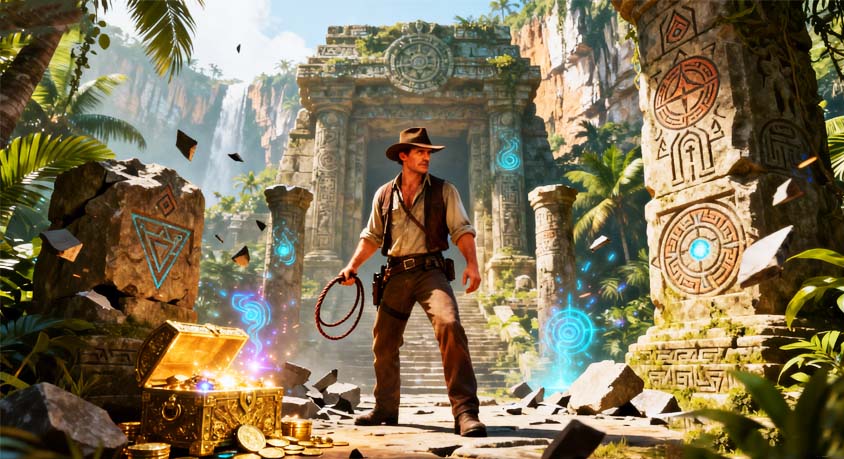
Let's be honest about the current state of the Xbox brand for a moment. It's been a rough couple of years. The promises of "the most powerful console" have faded into the background noise of a generation where exclusives actually matter, and Xbox has been, to put it charitably, light on the kind of system-selling blockbusters that make PlayStation owners feel smug and Nintendo fans feel validated. The strategy has shifted, pivoted, and reshuffled so many times that even dedicated fans are starting to get whiplash. Console exclusives are now also on PC. Some are even showing up on competing platforms. The message has become muddled, and the once-clear identity of Xbox as the place to play has blurred into a vague promise of "play anywhere" that sometimes feels like "play anywhere except here." Enter Indiana Jones and the Great Circle, a first-person adventure from MachineGames, the studio that brought us the gloriously over-the-top Wolfenstein reboots. It's a beloved IP, a talented developer, and a holiday release window. It's also, quietly, carrying the weight of an entire platform's hopes on its fedora-clad shoulders. The question isn't whether it's a good game. The question is whether one whip crack can undo years of strategic drift.
The first thing to acknowledge is that MachineGames is, on paper, an inspired choice for this project. Their Wolfenstein games understood something crucial about first-person storytelling: you need to feel like the protagonist, not just a floating camera with a gun. B.J. Blazkowicz worked because his gruff interiority was matched by the chaos around him. Indy requires a similar balance. You need to feel the wit, the weariness, the intelligence, and the occasional, bone-headed stubbornness of the character. A first-person perspective, done right, can put you inside that weathered leather jacket more effectively than any third-person camera. The promise of the game isn't just shooting Nazis (though that's certainly part of it); it's exploring tombs, solving puzzles, and feeling like you're living an actual, lost Indiana Jones movie. If anyone can deliver that, it's the team that made killing fascists feel both cathartic and narratively weighty.
But here's the uncomfortable truth that the game's fate hinges on: a great game isn't enough anymore. Not for a platform in Xbox's position. Starfield was, by most measures, a great game. It reviewed well. It sold well. And yet, it didn't move the needle on console sales the way Microsoft hoped. It didn't become the cultural phenomenon that The Legend of Zelda: Tears of the Kingdom was. It didn't make someone without an Xbox rush out to buy one. The problem isn't quality; it's identity. Xbox's exclusive strategy has been so scattered, so unfocused, that even a hit feels like just another game rather than a reason to own the box. Indiana Jones faces the same burden. It has to be not just good, but essential. It has to be the game people see and think, "I need to play that right now, and this is the only way."
This is made even more complicated by the shifting sands of Microsoft's own strategy. The company has signaled, through various leaks and executive statements, that exclusivity may not be the hill they want to die on. The future might be about Game Pass subscriptions and multi-platform availability, not selling consoles. So Indiana Jones exists in a strange limbo: it's positioned as a tentpole exclusive for a platform whose exclusivity strategy is actively being questioned by its own creators. It's the star player on a team whose owner is considering selling the franchise. The game might be brilliant, and it might still fail to "save" Xbox, not because it's bad, but because the definition of "saving Xbox" has become hopelessly muddled.
And yet, there's hope in that very muddle. Maybe Indiana Jones doesn't need to save Xbox. Maybe it just needs to be a damn good game that reminds people why they fell in love with this medium in the first place. Maybe it needs to capture that specific, irreplaceable feeling of stepping into an adventure, of cracking a whip and grinning as a boulder chases you down a temple corridor. MachineGames has the talent. Lucasfilm has the IP. The potential is undeniable. Whether that potential translates into a platform-defining moment depends less on the game itself and more on whether Xbox can remember who they are and what they're trying to be. Because right now, the great circle they're running in is their own confusion.
Disclaimer: Mention of any brand or trademark is for identification only and does not imply partnership or endorsement