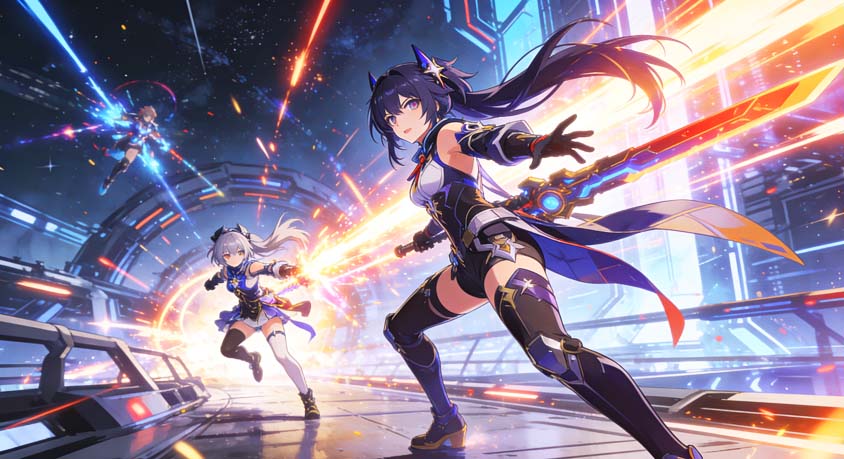
You're facing the latest Simulated Universe boss, the kind that normally deletes your team in two hits. You watch the turn order. The boss is at the top, ready to move. Your healer is third. Your tank is last. This is usually the moment you start sweating. But not this time. This time, you have a plan. Your support character acts. Their skill pushes the boss down the turn order. Your second support acts. Their ultimate pushes the boss down again. Your main damage dealer acts. Their talent pushes the boss down a third time. The boss's turn never comes. It sits there, at the bottom of the list, watching your team take turn after turn after turn. You're not fighting the boss. You're letting it watch you fight. And by the time it finally gets to move, if it ever gets to move, it's already dead. This isn't a glitch. This isn't luck. This is Honkai: Star Rail at its most beautiful, its most cruel, its most satisfying. This is the art of never letting the enemy play the game.
The secret, if you haven't discovered it yet, is the action value system. Every character in Star Rail has a speed stat. That speed determines how often they act. But speed isn't fixed. It can be manipulated. There are characters who can advance their own actions, pulling themselves up the turn order. There are characters who can advance their teammates' actions, giving them extra turns. There are characters who can delay enemy actions, shoving them down the list. There are light cones that add action advance. There are relics that add action advance. There is a whole, glorious, deeply underutilized system built around the simple idea that if you control the turn order, you control the fight.
The core of the strategy is building a team where every character contributes to the same goal: the boss never moves. You need a primary action advancer, someone like Bronya or Sparkle, who can pull your damage dealer up the turn order. You need a secondary support who can either advance further or delay the enemy, someone like Ruan Mei or Welt. You need a damage dealer who can benefit from all these extra turns, someone who doesn't need to wait for setup, who can just hit hard every time they act. And you need enough speed on everyone that the gaps between turns are smaller than the boss's window to recover.
The mechanics get intricate. Action value is measured in units. A character with 100 speed will act every 100 units. A character with 200 speed will act every 50 units. When you advance an action by 50 percent, you're effectively halving that character's wait time. When you delay an enemy by 30 percent, you're adding 30 units to their wait time. Multiply these effects across a team of four characters, and you're not just controlling the turn order. You're building a machine where your team cycles faster than the enemy can recover. The boss sits at the bottom of the list, watching you take three, four, five turns for every one of theirs, waiting for a turn that never comes.
The beauty of this strategy is that it works on almost every boss in the game. The bosses that are immune to crowd control, the ones that can't be frozen or imprisoned, they still have a turn order. They still have action value. They can't be made immune to being pushed down the list. That's not a status effect. That's just physics. The game's turn system is fundamental. It can't be turned off. So if you can control it well enough, you can make any boss, any enemy, any challenge, irrelevant. They don't get to play. You do.
For the player who masters this, Star Rail becomes less about reacting and more about engineering. The audience for this approach is anyone who enjoys breaking systems. It's for the theorycrafters, the speed tuners, the people who look at a turn-based game and ask, "What if the turns were only mine?" It's for players who are tired of grinding for perfect relics and want a strategy that rewards understanding over luck. The game asks you to learn the math, to understand action values, to build teams with purpose. And when it works, when the boss takes its first turn at 10 percent health, you'll understand why speed is the most powerful stat in the game.
A few things to know before you start building your infinite turn machine. This requires specific characters. Not every team can do this. The action advancers are limited, and the most effective ones are five-star units. Speed tuning takes work. You need to know your characters' base speeds, the action value of their skills, the exact percentage of their advances. The margin for error is small. If your speed is off by a few points, the boss might slip through, get one attack, and wipe your team. But when it works, when everything lines up, you're not just winning. You're controlling time itself.
Disclaimer: Mention of any brand or trademark is for identification only and does not imply partnership or endorsement