Have you ever had one of those days where your Zoom call freezes right as your boss is about to announce promotions? The spinning wheel of death appears, and you're left screaming at a pixelated face, completely powerless. It's annoying, sure.
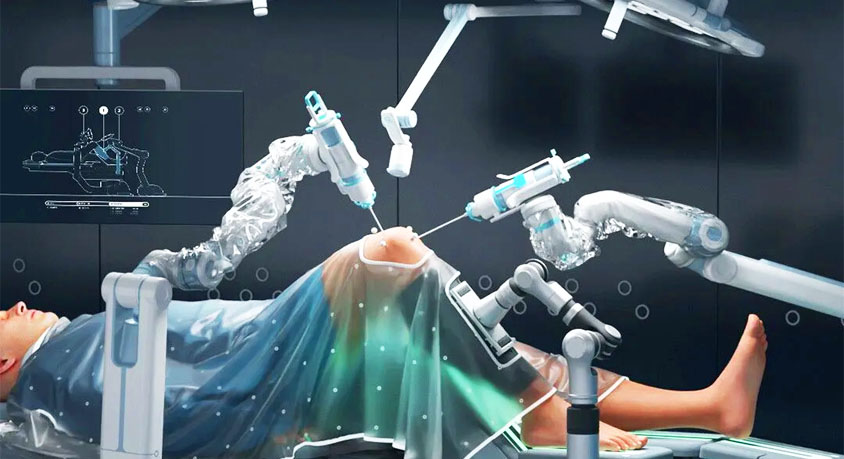
I was down a rabbit hole on Reddit last week when someone posted a video that stopped my scroll cold. A cardiac surgeon in New York, wearing what looks like a designer version of VR goggles, is manipulating a set of controls with fingers so delicate they barely move. On a massive monitor, you see a robotic arm inside a chest cavity in Los Angeles, stitching a coronary artery. The surgeon's hands aren't touching the patient. They aren't even in the same time zone.
The distance between his morning coffee in Manhattan and that operating table on the West Coast was roughly 2,800 miles. The only bridge across that gap was a 5G signal traveling at the speed of light, with a latency of just 30 milliseconds. That's less time than it takes for you to blink, less than the delay between a lightning strike and the thunder you hear. It's the difference between life and death written in microseconds.
This isn't some speculative tech demo cooked up for a TED Talk. Remote robotic surgery has been technically possible for years, but the network infrastructure always played the role of the unreliable friend who shows up late. 4G had a jitter. Satellites were delayed. But the rollout of true 5G networks with network slicing—basically carving out a dedicated, ultra-reliable lane for critical data—changes the entire game. When a surgeon's hand tremor is filtered out by algorithms before the robot even receives the command, the barrier isn't geography anymore. It's physics, and we're winning.
Imagine a car accident victim in rural Montana, hours from a trauma center. Right now, that's a race against the clock they often lose. But with a robotic arm in a local clinic connected to a specialist in Seattle, the clock slows down. The specialist can perform emergency procedures remotely, stabilizing the patient before a helicopter even lifts off. The same logic applies to battlefield medicine, where moving a surgeon to the front lines is often impossible, but moving a signal is trivial.
The technology behind this is a masterpiece of IoT engineering. The surgical robot is essentially the most advanced smart device you've never used, packed with sensors that capture every micro-movement and transmit it with haptic feedback. This means the doctor in New York can actually feel the resistance of the tissue they're cutting in Los Angeles. It's not a video game. It's the opposite of a video game—it's reality, enhanced by connectivity to remove the physical limitations of the human body.
A study published in Nature last year highlighted that remote surgery with sub-50ms latency shows no significant difference in outcomes compared to on-site procedures. That's the statistical threshold where distance becomes irrelevant. We've crossed it. Now it's about scaling the infrastructure, training more surgeons on these consoles, and convincing hospital boards that investing in robotic arms and fiber optics is as essential as buying another MRI machine.
The narrative around healthcare has always been about bringing the patient to the expert. Build the big hospital in the big city, and hope everyone can get there in time. This flips that model completely. It brings the expert to the patient, through a fiber optic cable and a robotic arm, without the doctor ever having to pack a suitcase or deal with TSA.
So the next time your video call buffers, cut the network some slack. Just remember that somewhere, a team of engineers is obsessing over those milliseconds so that one day, when it really counts, the connection stays so crisp that a surgeon on one coast can save a life on another. And honestly, that's the kind of latency I can live with.
Disclaimer: Mention of any brand or trademark is for identification only and does not imply partnership or endorsement