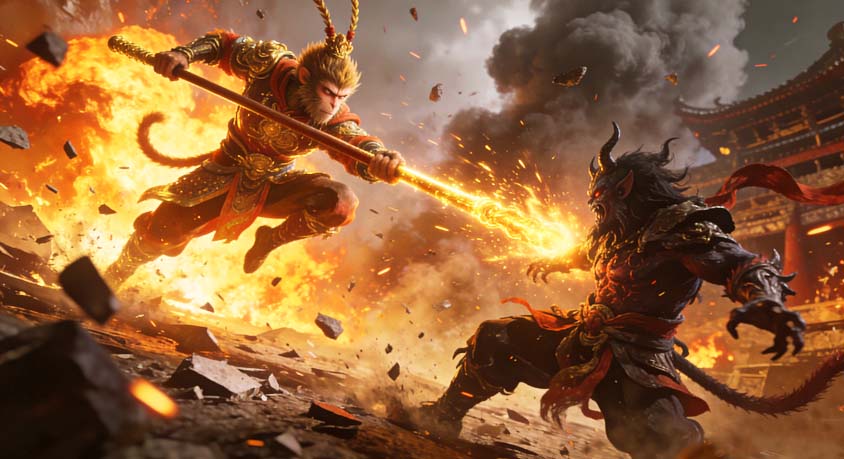
There's a moment in the early trailers for Black Myth: Wukong that seems to have bypassed the brains of many Western critics and gone straight to their adrenal glands. It's the moment our simian hero, staff in hand, faces down a towering, multi-limbed deity in a thunderstorm. The visual language is unmistakable: this is a top-tier, cinematic action game. The comparisons to Dark Souls and God of War were instant and understandable. Yet, as the dust from the initial hype settles and the Metacritic scores stubbornly refuse to form a unanimous choir of praise, a fascinating cultural rift has emerged. The polarization isn't really about the graphics or the combat—which are largely praised—but about something far more subtle and significant. It's about what happens when a game isn't just translated in language, but asks to be understood in context, and a significant portion of its new audience shows up without the required dictionary.
Many Western critiques land on a similar, frustrated note: "The world is stunning, but the story feels... distant. The lore is impenetrable. Who are all these gods? Why should I care?" This is the core of the cultural collision. For players raised on the archetypal heroes' journeys of Greek myth or the standardized fantasy tropes of Tolkien-derivatives, Journey to the West isn't a foundational text. It's a bizarre, centuries-old Chinese novel full of bureaucratic deities, philosophical tangents, and a protagonist who is less a noble hero and more an immensely powerful, rebellious trickster. The game assumes a baseline familiarity—or at least a willingness to acquire it—that simply doesn't exist for the average American player. So, when a pig-man spirit shows up or a Buddha statue speaks, a Chinese player might feel a thrill of recognition, while a Western player sees a cool, but ultimately random, monster design. One person's profound mythological reference is another's confusing non-sequitur.
This is where the "secret" lies, and it's not a flaw in the game, but a gap in the shared cultural vocabulary. Western game narratives often spoon-feed context. We get codex entries written for outsiders. Wukong often does not. Its storytelling is frequently elliptical, told through environmental details, item descriptions that presume knowledge, and battles that are themselves mythological arguments. Fighting the Black Wind Demon isn't just a boss fight; it's a playable chapter from a classic tale. If you don't know the tale, it's just a hard fight against a wolf with a spear. The game is a breathtakingly detailed mural, and some critics are reviewing it from three inches away, complaining about the brushstrokes they don't recognize, rather than stepping back to see the epic picture it's a part of.
Does this make the negative critiques "wrong"? Not entirely. It highlights a legitimate barrier to entry. But it does make them incomplete. To dismiss Wukong for being culturally dense is like dismissing Hamlet for having too many Danes. The game's ambition is precisely to be an authentic, deep dive into its source material, not a watered-down, globally-sanitized version. The polarization on Metacritic is, therefore, a referendum on this approach. One side sees a gimmick—a "pretty Souls clone with a weird story." The other sees a landmark: the first AAA-grade video game to demand that the global gaming mainstream meet Chinese mythology on its own terms, with all its complexity and strangeness intact.
So, is it a masterpiece or a gimmick? Perhaps it's both, depending on which side of the cultural lens you're on. For those willing to do a little homework—to embrace the confusion and let the game's majestic, wordless storytelling through combat and landscape wash over them—it can be a transformative experience, a window into a narrative universe as rich as any in the West. For others, it will remain a beautiful, frustrating artifact, a locked door to a party they don't have the invite for. The truth Black Myth: Wukong forces us to see that in a globalized market, sometimes the most radical thing a game can be is unapologetically, gloriously local. And that, in itself, is a kind of revolution, even if not everyone is ready to join the fight.
Disclaimer: Mention of any brand or trademark is for identification only and does not imply partnership or endorsement