There is a peculiar vulnerability that sets in around 11 PM in a hotel room. The door is locked. The deadbolt is thrown. The chain is latched. By every conventional measure, the room is secure. And yet, for anyone who has spent time in short-term rentals or budget hotels, there is a quiet awareness that the door has passed through dozens of hands before yours—previous guests, housekeeping staff, maintenance workers, property managers. A lock is only as trustworthy as the number of people who have held the key. The physical security of a hotel room relies on an assumption that the key distribution chain has remained intact. In practice, that assumption is frequently violated. According to data from the American Hotel and Lodging Association, security incidents in guest rooms, including unauthorized entries, account for a significant percentage of reported safety complaints across the industry.
The first layer of portable IoT security addresses this vulnerability not by replacing the lock but by supplementing it with a device that requires no installation. A wedge-style door alarm sits on the floor, its angled shape sliding under the door. When pressure is applied from the outside—the door opening inward—the wedge compresses, triggering a 120-decibel alarm. The device does not connect to Wi-Fi. It operates on a simple electromechanical principle: a physical intrusion completes a circuit. The value of this simplicity is that it requires no setup, no pairing, no dependence on local internet connectivity. It works in a remote cabin with no signal as reliably as it works in a high-rise hotel. The traveler places it before sleep and removes it in the morning. The device does not ask for trust. It enforces a physical barrier that announces its own violation.
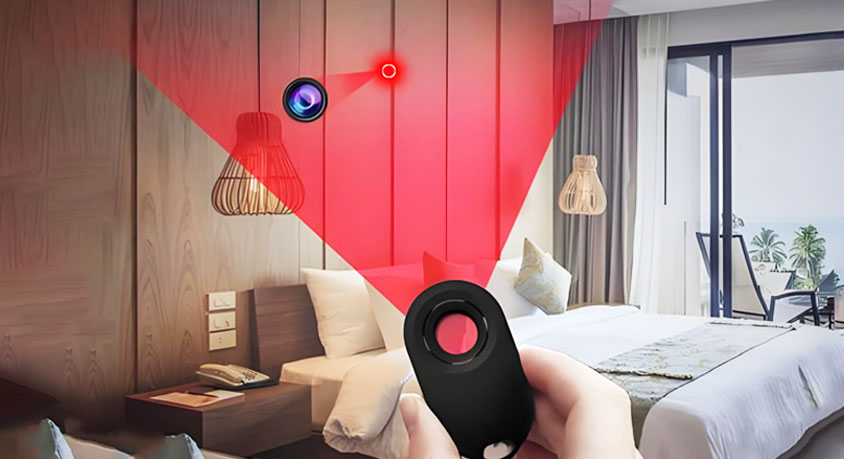
The second layer addresses a threat that is less visceral but statistically more common: unauthorized surveillance. Hidden cameras in short-term rentals have become a recurring issue, with consumer advocacy groups documenting cases in Airbnb listings, hotel rooms, and even changing rooms. The devices are often embedded in everyday objects—smoke detectors, alarm clocks, USB chargers, air vents. Visual inspection alone is unreliable. The most effective countermeasure is not a camera lens detector, which requires line of sight and active scanning, but a radio frequency signal detector. These handheld devices sweep the surrounding area for electromagnetic emissions in the 1 GHz to 8 GHz range, the frequencies commonly used by wireless cameras transmitting video. When a signal is detected, the device alerts the user through a series of LEDs or audible tones, allowing them to locate the source through signal strength triangulation.
The technical mechanism here is worth understanding because it explains why these devices work where smartphone apps fail. Many hidden cameras transmit on Wi-Fi, and apps that scan for devices on a local network can identify some of them. But a sophisticated or hardwired camera may not broadcast its presence on a visible network. An RF detector operates at the physical layer, not the network layer. It listens for the raw transmission regardless of whether the signal is encrypted or associated with a known network. It does not require the user to connect to the property’s Wi-Fi, which in itself carries security risks. The device sits in the travel bag, deploys in five minutes, and provides a passive scan that requires no technical expertise.
There is a third category that sits between these two: portable Wi-Fi scanners that assess the security of the property’s network. For travelers who work remotely or access sensitive accounts from hotel rooms, the risk is not only physical intrusion but digital interception. A portable travel router with built-in VPN capabilities can create a personal network that tunnels traffic through an encrypted channel regardless of the property’s network security. Some devices go further, performing network scans to detect rogue access points that may be impersonating the hotel’s official Wi-Fi. This layer does not protect against hidden cameras directly, but it closes the other vector through which a compromised room can become a compromised identity.
The common thread across these devices is that they shift the burden of security from trust to verification. A hotel guest has no way of knowing whether the housekeeping key card was returned by a former employee. They have no way of knowing whether the previous guest left a camera disguised as a phone charger. The conventional response is to assume the best, because the alternative—constant vigilance—is exhausting and unsustainable. Portable IoT security devices offer a different path. They do not require constant attention. They require a few minutes of setup at check-in and then operate autonomously, providing verification that the environment is safe or alerting when it is not.
The limitations are real. A door alarm does not prevent entry; it announces it. An RF detector will not find a camera that stores footage locally rather than transmitting wirelessly. A travel router cannot protect against a compromised device that the user voluntarily connects. But these limitations reflect a fundamental truth about security: no single layer is sufficient. The goal is not perfection. It is to raise the cost of intrusion high enough that the intruder moves to an easier target. The traveler carrying a wedge alarm and an RF detector is not invulnerable. They are simply less vulnerable than the traveler who assumes the lock is enough.
What makes these devices particularly suited to modern travel is their independence from the property’s infrastructure. They do not require a smart home hub. They do not need to connect to the local Wi-Fi. They do not depend on the property manager’s goodwill or the hotel chain’s security protocols. They are self-contained, battery-powered, and deployable anywhere there is a door and a power outlet. For the traveler who moves between hotels, short-term rentals, and the homes of friends, this portability is not a convenience. It is the only form of security that travels with them.
Disclaimer: Mention of any brand or trademark is for identification only and does not imply partnership or endorsement