A cardiologist looks at your echocardiogram. The images show a valve that does not close properly, a chamber that is slightly enlarged, a pattern of blood flow that is not quite right. From these images, they make a recommendation: a repair, a replacement, a medication. They base this recommendation on guidelines developed from population studies, on their experience with hundreds of previous patients, on intuition that has been refined over years. They are making a prediction about how your heart will respond to an intervention. But they are doing it without ever testing the intervention on your heart. They are extrapolating from others to you.
What if the order were reversed? What if, before any intervention touched your body, a virtual version of your heart was built—an exact replica, not just in shape but in electrical conductivity, tissue stiffness, fluid dynamics—and that replica was tested against every possible treatment? The valve replacement that looks promising on the echocardiogram might fail in the digital model because of an unusual anatomy the images did not capture. A medication that standard protocols recommend might be shown to have no effect on your specific geometry. A different approach, one the cardiologist would not have considered, might emerge as the optimal path. Only after the digital heart has been tested against a thousand simulated interventions does the real procedure begin.
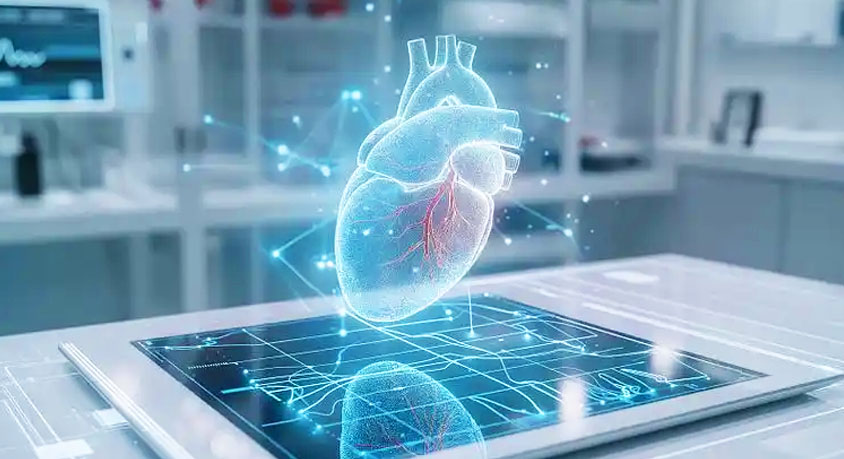
This is the logic of the cardiac digital twin, a technology that has moved from research labs into clinical practice over the past several years. It begins with medical imaging: CT, MRI, echocardiography. From these images, a computational model is constructed that represents not just the geometry of the heart but its function. The model incorporates the electrical signals that trigger each beat, the mechanical properties of the muscle tissue, the flow of blood through chambers and valves. It is not a static 3D rendering. It is a physics-based simulation that beats, pumps, and responds to stress in the same way your heart does.
The construction of such a model requires solving equations that describe the coupled physics of electrophysiology, solid mechanics, and fluid dynamics. This is computationally intensive. A single simulation can require hours on a supercomputer. But the result is a personalized testbed: a heart that can be subjected to any intervention without risk to the patient. The surgeon can try different incision patterns, different valve placements, different pacing strategies. The interventional cardiologist can test stent sizes, deployment angles, flow outcomes. The electrophysiologist can map ablation targets, simulate the spread of electrical signals, predict which areas will trigger arrhythmias.
The clinical applications are already established in certain domains. For patients with severe aortic stenosis, a condition where the heart’s outflow valve narrows, the standard treatment is transcatheter aortic valve replacement—a new valve delivered through a catheter and expanded inside the old one. The risk is that the new valve will not seat properly, or that it will block the coronary arteries, or that it will leak. A digital twin of the patient’s aortic root can test the deployment of different valve sizes and types before the real procedure, predicting which combination will produce the best seal with the lowest risk. The procedure that once relied on the operator’s judgment now has a simulated rehearsal.
For patients with arrhythmias like atrial fibrillation, the standard treatment is ablation: burning or freezing small areas of heart tissue to interrupt the abnormal electrical signals. Identifying the right targets is difficult. The electrical patterns are complex, and the source of the arrhythmia is not always where it appears to be. A digital twin of the heart’s electrical system can simulate the spread of signals, identify the points where they originate and propagate, and test the effect of ablating different locations. The procedure can be planned in advance rather than mapped in real time under anesthesia. The patient spends less time in the operating room. The outcomes are more predictable.
The deeper implication of this approach is not simply better outcomes for individual patients. It is a shift in the epistemology of medicine. The traditional model is empirical: we try treatments on populations, observe outcomes, and derive guidelines. The individual patient is then treated according to guidelines derived from others. The digital twin model reverses this. It creates a virtual patient that can be experimented upon without risk. The treatment that works in the simulation is then applied to the real patient. The order of knowledge production changes. Instead of learning from populations and applying to individuals, we learn from the individual’s simulation and apply only what works for them.
There are limits to what the technology can currently achieve. The models require high-quality imaging that is not universally available. They require computational resources that are not present in every hospital. They require validation: we know that the simulation matches the real heart under certain conditions, but we do not know how well it predicts outcomes that take years to manifest. A digital twin that correctly simulates blood flow through a replaced valve today may not accurately predict how that valve will perform in five years as the patient’s heart changes. The models are improving, but they are not yet complete.
There is also a question of access. The patients who receive digital twin-guided procedures today are typically those at high risk where the standard approach is uncertain. The technology is not yet scaled to routine care. It is expensive. It requires specialized expertise. The infrastructure to build these models is concentrated in academic medical centers and a handful of commercial entities. Whether it spreads to community hospitals and reaches the patients who would benefit most depends on cost reduction, automation, and the willingness of payers to reimburse not just the procedure but the simulation that precedes it.
What makes this development worth attention is not that digital twins will replace clinical judgment. They will not. The cardiologist still decides which interventions to simulate, interprets the results, and decides when to trust the model. But the relationship between judgment and evidence shifts. The evidence is no longer only population data and clinical experience. It is also a simulation of the specific patient’s physiology, tested under conditions that cannot be replicated in the real body. The physician becomes not just a practitioner of medicine but a reader of simulations, an interpreter of models that are themselves interpretations of imaging data.
Disclaimer: Mention of any brand or trademark is for identification only and does not imply partnership or endorsement