
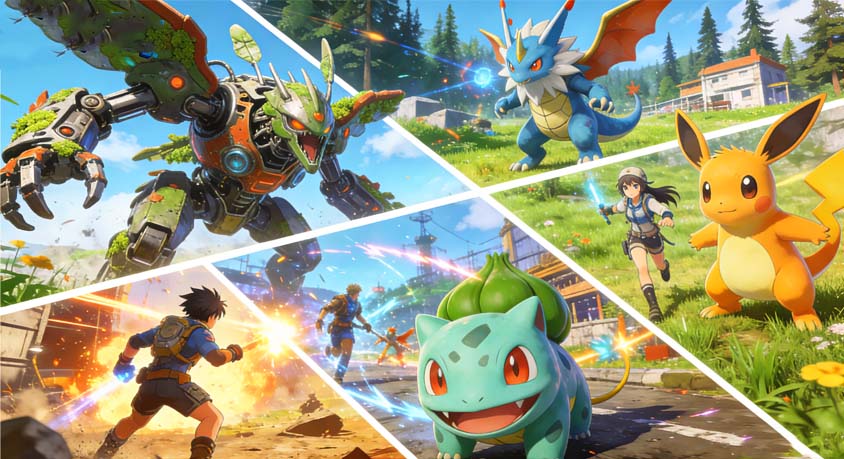
Palworld arrived with the subtlety of a rocket launcher in a preschool. It looked like Pokémon, if Pokémon had been raised on a diet of automatic weapons and industrial labor laws. The internet did what the internet does: it memed. "Pokémon with guns," they called it. "Copyright infringement waiting to happen." And then, something unexpected happened. Players didn't just buy it; they devoured it. Twenty-five million copies in a month. Concurrent player counts that made AAA studios weep with envy. A cultural phenomenon that refused to be dismissed as a joke. Now, Nintendo's lawyers are circling, and the discourse has shifted from "is this funny?" to "is this legal?" But buried under the legal threats and the meme-ification is a more uncomfortable question: why did a game that looks like a knockoff succeed where the real thing has, for many players, started to feel stale? The answer isn't about theft. It's about what happens when a beloved franchise stops listening, and a scrappy underdog starts paying attention.
Let's address the elephant in the room first: yes, the creatures in Palworld look like they could be distant, slightly unhinged cousins of Pikachu and Charizard. The visual similarity is undeniable, and it's clearly deliberate. But here's the thing about inspiration versus imitation: Palworld isn't trying to be Pokémon. It's trying to be everything Pokémon fans have been begging for, for decades, while Game Freak smiled politely and released another slightly tweaked version of the same formula. You want a world that feels alive and dangerous? Palworld gives you ecosystems where creatures hunt each other, where you have to survive, where exploration carries real risk. You want your creatures to feel like partners, not just battle tools? Palworld lets you assign them jobs, build them housing, watch them interact with the environment. You want combat that feels impactful and dynamic? Palworld gives you guns, actual guns, and real-time action that makes the turn-based battles of Pokémon feel like a relic from a gentler age. The game isn't a rip-off; it's a wishlist, rendered in code and sold for thirty dollars.
This is the uncomfortable truth that Nintendo's legal team is wrestling with: you can't sue someone for making the game players actually wanted. The "Pokémon with guns" meme is funny, but it's reductive. What Palworld really represents is a generation of players who grew up with Pokémon, who loved it deeply, and who have spent years watching it stagnate. The same formula, the same structure, the same cautious, risk-averse design philosophy. Pokémon became a museum piece, lovingly preserved but never truly evolving. Palworld came along and said, "What if we took that museum piece and set it on fire, then built something new from the ashes?" The result is chaotic, unbalanced, and occasionally broken. It's also the most fun many players have had with a creature-collector in years.
Now, let's talk about the legal line, because it matters. Copyright law doesn't protect ideas; it protects expressions of ideas. You can't copyright the concept of collecting creatures. You can't copyright the idea of type advantages or evolution. What you can copyright are specific designs, specific characters, specific visual elements. And here's where Palworld has played a dangerous but potentially legal game. Their creatures are just different enough, just distinct enough, to arguably fall on the right side of the line. Anubis isn't Lucario; he's an Egyptian god-inspired design with a different silhouette. The argument will rage in courtrooms and comment sections for years. But for the 25 million people who bought the game, the distinction is irrelevant. They didn't buy a legal argument. They bought a fantasy they'd been waiting decades to play.
The irony, of course, is that Nintendo's lawsuit threat might be the best marketing Palworld could have asked for. Nothing says "this game is dangerous" like a legal threat from the most protective company in gaming. Nothing says "the establishment is scared" like lawyers descending on an indie success story. The players see a David versus Goliath narrative, and they know which side they're on. They're on the side of the game that finally gave them what they wanted.
So, is Palworld a masterpiece or a theft? It's both. It's a game built on the shoulders of giants, borrowing liberally from the best in the business while adding its own chaotic twist. It's a reminder that innovation often looks like imitation at first glance. And it's a warning to every dominant franchise that resting on your laurels is the fastest way to lose your crown. Because if you won't make the game your fans want, someone else will. And they might just put guns in it.
Disclaimer: Mention of any brand or trademark is for identification only and does not imply partnership or endorsement