



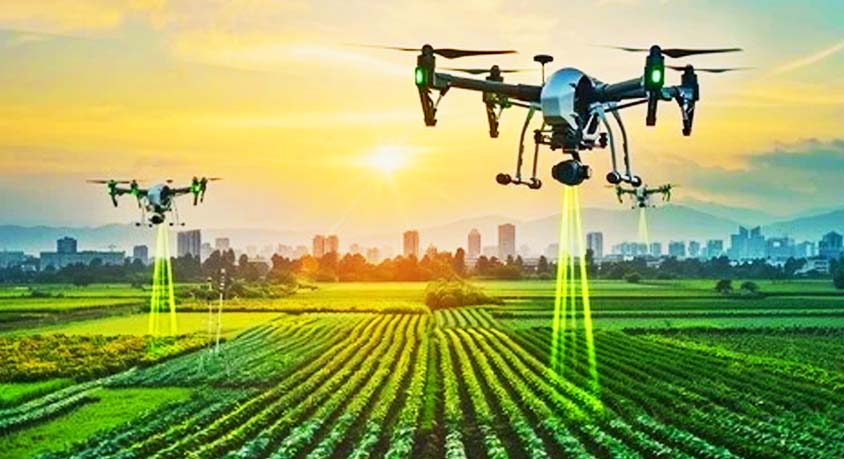
At dawn over a five-thousand-acre soybean field, a low hum emerges. Not from one source, but from dozens. A swarm of fifty compact drones lifts off from a mobile charging station, their flight paths a pre-programmed ballet. Some descend to six inches above the crop canopy, using multispectral cameras to diagnose nitrogen deficiency leaf by leaf. Others hover over irrigation pivots, checking for mechanical faults. A third group, equipped with micro-sprayers, delivers a precise dose of pesticide only to the corners of the field where sensors detect pest eggs. This is precision swarm agriculture in 2026—a system of distributed, autonomous aerial agents that manage vast tracts of land with minimal human intervention. The efficiency gains are quantifiable: 30% less water, 50% less chemical use, 15% higher yield. The system’s resilience, however, is built on a fragile digital scaffold. A single point of failure could turn this symphony of efficiency into chaos.
The technology operates on a hierarchy of autonomy. Think of the swarm not as individual robots, but as a single distributed organism with a simple collective intelligence. Each drone is a limb or sensor. They communicate via a mesh network, constantly sharing position, battery status, and task completion data. A central "hive mind" algorithm—running either on a local server or in the cloud—orchestrates their movements to avoid collisions and optimize coverage. The drones use GPS for broad navigation, but their precision work relies on visual odometry and LiDAR to see the world immediately around them. Their programming is goal-oriented: "map field A3," "treat weeds in sector D7." They are not making high-level decisions; they are executing a detailed playbook transmitted from the control system. This architecture is the source of both its power and its peril.
The critical vulnerability is the command, control, and communications (C3) link. The swarm depends on constant data flow. A hacker or adversary doesn't need to hijack every drone; they only need to compromise the C3. Several attack vectors exist. A GPS spoofing attack could feed the entire swarm false coordinates, causing them to fly off-course, crash, or spray the wrong field. A jamming attack on their communication frequencies could sever the mesh network, causing drones to default to isolated, pre-programmed safe modes or, worse, to collide with each other. The most sophisticated threat is a malicious takeover of the hive mind server. With control of the algorithm, an attacker could repurpose the swarm in minutes. The tools for agriculture—cameras, sprayers, and the drones themselves—become weapons.
The transformed threat is both economic and physical. An attacker could command drones to dump their entire chemical payloads in a concentrated area, creating toxic zones and killing crops. They could be directed to physically ram into farm infrastructure, livestock, or even humans. A swarm of disoriented drones crashing into a grain elevator or fuel depot could cause catastrophic fires. The scale is what makes it terrifying: a single exploited vulnerability can weaponize an entire fleet of fifty or a hundred drones simultaneously, turning an agricultural asset into a wide-area, automated menace. The motivation could be economic sabotage by a competitor, ideological activism, or simply ransom.
Therefore, the operational security protocol for farm swarms must be militaristic in its rigor. First, enforce physical and network isolation. The swarm's control system must operate on a physically separate, air-gapped local area network. It should never be connected to the farm's general internet connection. All data transfers should occur via encrypted, physical media (like secured USB drives). The base stations and control servers should be in locked, access-controlled enclosures. Second, implement redundant, spoof-resistant navigation. Augment GPS with local, ground-based radio navigation beacons (like eLoran) and vision-based systems that recognize landscape features. The swarm should cross-reference multiple navigation sources and freeze in place if a significant discrepancy is detected. Third, build in swarm-level "dead man switches." Program immutable, low-level behavioral rules that override any central command. For example: "If communication is lost for more than 60 seconds, return immediately to the home coordinates via a pre-mapped safe altitude corridor and land." or "If payload is activated outside of a pre-defined geofenced mission polygon, shut down motors immediately."
The agricultural drone swarm is a powerful tool that concentrates both capability and risk. Your goal is not to avoid the technology, but to harden its implementation against the inevitable attack. Treat the C3 system as a critical fortress. Assume the communication links are under constant, passive surveillance. Design for graceful degradation under attack, not just optimal performance in peace. The future of farming depends on resilience as much as on yield. Secure the hive mind, or the swarm that feeds millions could be the same one that destroys a harvest in an afternoon. Deploy with redundancy, operate in isolation, and program for disobedience to any illegitimate command. Your most important crop is not corn or soy; it is operational security.
Disclaimer: Mention of any brand or trademark is for identification only and does not imply partnership or endorsement