Let me take you back to a specific Saturday morning in 1995. You're on the floor in your pajamas, cereal bowl within reach, watching Sailor Moon transform for the first time. The colors are impossibly bright. The eyes are impossibly large. The whole world has a sparkle to it that real life, you're slowly learning, just doesn't have. Now imagine growing up, paying bills, staring at spreadsheets, and one day discovering that someone has built an entire video game that looks exactly like that Saturday morning felt. That's the Fields of Mistria. It's a farming sim that wears its 90s anime heart on its pixelated sleeve, and it has quietly become the most emotionally immersive escape I've found in years. I didn't just start playing this game. I moved into it. I pay virtual taxes here now. My real-life apartment is just where my body goes when the wifi is down.
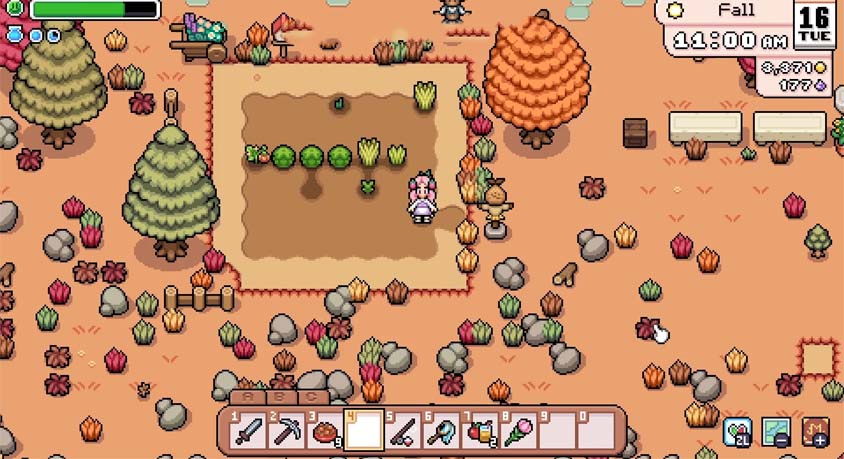
The first thing you notice, before you plant a single crop or talk to a single villager, is the aesthetic. This game is a love letter to the golden age of shoujo anime. The character sprites have those enormous, expressive eyes that somehow convey entire emotional novels in a single blink. The color palette is all soft pastels and magical sunsets. The world itself, a charming valley nestled between misty mountains and sparkling rivers, feels like it was plucked directly from an opening credits sequence you can't quite remember but deeply miss. Every screen is a postcard. Every character introduction feels like meeting a new friend in a coming-of-age story. The pixel art isn't just nostalgic; it's transportive. It pulls you into a specific emotional space, a place where problems are solvable and people are fundamentally kind.
Underneath that gorgeous surface, the gameplay is deceptively deep. You arrive in Mistria with a rundown farm and big dreams. The core loop is familiar to anyone who's played a farming sim: clear land, plant crops, raise animals, mine for resources, fish in the rivers, befriend the locals. But the execution elevates every system. The farming mechanics have satisfying depth, with soil quality, seasonal rotations, and crop mutations to discover. The mining is genuinely engaging, with procedurally generated caves and secrets tucked in every corner. The fishing minigame is actually fun, which in gaming terms is a minor miracle. And the crafting system ties everything together, letting you build and customize your farm into something that feels genuinely yours.
But the real magic, the thing that keeps me coming back long after the crops are watered, is the social system. The villagers of Mistria aren't just quest dispensers with walking animations. They have lives, schedules, relationships, and secrets. They remember your conversations. They react to your gifts with genuine personality. They change over time, opening up as you earn their trust. The romance options are plentiful and wonderfully written, each with their own arc, their own struggles, their own reasons for being in this valley. I've found myself genuinely invested in whether the shy librarian will finally confess to the blacksmith. I've cheered when two villagers became friends because I kept mentioning them to each other. The game turns its town into a living community, and you into a part of it.
This is the game's secret weapon: it makes you care. Not in the abstract way you care about completing a checklist, but in the real way you care about people you know. The pixelated faces start to feel like actual neighbors. Their problems become your problems. Their joys become your joys. When a villager remembers your birthday and throws you a party, it doesn't feel like programmed content. It feels like friendship. When another villager shares a childhood memory, it doesn't feel like exposition. It feels like trust.
The audience for this game is anyone who's ever felt a little alone. It's for people who grew up on 90s anime and never quite found that sparkle in real life. It's for farming sim veterans looking for the next great obsession. It's for romance enthusiasts who want more than just a few dialogue options. It's for anyone who needs a place where the sunsets are always pretty and the people are always worth knowing. The game asks for your time, and it rewards it with genuine connection.
A few things to know before you move in. The game is in early access, which means more content is coming, but the existing world is already rich and complete enough to lose yourself in for dozens of hours. The pixel aesthetic is deliberate; if you need photorealism, this isn't it. And the emotional investment is real; you will genuinely miss these people when you close the game. But that's not a warning. That's an invitation.
Disclaimer: Mention of any brand or trademark is for identification only and does not imply partnership or endorsement