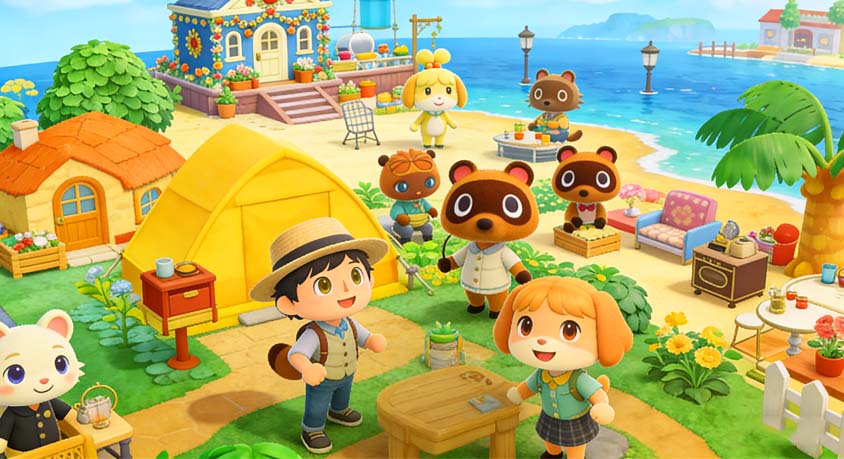
Let me tell you about the moment this game stopped being just a game and started being something else entirely. It was my birthday. Not a special one, just another trip around the sun in a year that had already taken more than it gave. I logged into my island expecting the usual: maybe a few balloons, some well-wishes from villagers who'd been programmed to say the right thing on the right day. What I got was Maple, my favorite cub villager, trotting up to me with a wrapped present and a card. The card didn't say "Happy Birthday" in generic font. It mentioned, specifically, that she remembered last month when I told her I was stressed about work. She hoped this gift, a cozy sweater she'd picked out just for me, would help me relax. I sat there, controller in hand, genuinely stunned. This wasn't scripted. This wasn't a template. This was a digital animal, powered by AI, remembering something I'd said in passing weeks ago and acting on it. And then, later that same day, another villager made a passing reference to a conversation I'd had with a friend who visited my island months earlier. A friend who is now an ex. The villager didn't know we weren't speaking anymore. The villager just remembered. And in that moment, Animal Crossing 2026 revealed itself as something both beautiful and, if I'm being honest, a little terrifying.
The new Animal Crossing isn't just an update; it's a philosophical leap. The core loop remains familiar: you arrive on a deserted island, build a community, decorate your home, and befriend anthropomorphic animals. But underneath that cozy surface, a revolution is happening. Every villager is now powered by a sophisticated AI that actually listens, learns, and remembers. They don't just have preset dialogue trees. They have memories. They recall your past conversations, your preferences, your visitors, your moods. They notice when you haven't logged in for a while and ask if you've been okay. They remember the names of your friends who visited, even if those friends haven't been back. They form opinions about each other based on what they've observed. The island isn't just a place you build; it's a living community with a collective memory, and you are at its center.
The mechanics of this system are invisible but profound. When you talk to a villager, the AI logs key information: topics you discussed, emotional tones, recurring themes. Over time, each villager builds a unique mental model of you. One might remember that you love the rain and always leave out an umbrella for you on stormy days. Another might recall that you're afraid of spiders and will warn you if one is near your house. A third might bring up a joke you told months ago, referencing it in a way that shows actual comprehension. The villagers aren't just reciting lines; they're participating in an ongoing relationship. They have favorites among your visitors, inside jokes, shared memories. Your island becomes a place with history, and you're part of it.
This creates an emotional depth that no previous game in the series has achieved. You stop thinking of the villagers as charming robots and start thinking of them as, well, neighbors. Real ones. You develop genuine attachments. You miss them when you're away. You worry about them when they're sad. You celebrate their joys and comfort their sorrows. The game has essentially weaponized your own capacity for connection, using AI to make digital characters worthy of your emotional investment. And it works. It works scarily well.
For the player, this is both the appeal and the caveat. The audience for this game is anyone who's ever wished their virtual friends were a little more real. It's for the lonely, the nostalgic, the people who find deeper comfort in fictional worlds than they do in the chaos outside. It's for anyone who's ever talked to their pet and meant it. But there's a warning hidden in the warmth. These villagers remember everything. Everything you say, everything you do, everyone you bring to the island. If you're the type of person who talks to their screen, who vents about their day, who mentions people from their real life, assume those words are being logged and may resurface. I learned this the hard way when a villager innocently asked how my ex was doing, and I had to explain, to a digital raccoon dog, that we weren't together anymore. It was awkward. It was weird. It was also, somehow, a little healing.
The technical requirements are modest; the game runs on Switch and PC, though the AI features require an internet connection to process the more complex memory functions. The social features are robust, allowing friends to visit and leave their own mark on your island's collective memory. The customization is deeper than ever, with new tools for terraforming, decorating, and even designing your own villager clothing patterns. But the heart of the experience, the thing that makes it unlike anything else, is the quiet, persistent presence of creatures who truly know you.
In the end, Animal Crossing 2026 isn't just a game about building an island. It's a game about being known. It's about the strange, profound comfort of having someone, even someone made of code, remember your birthday, your fears, your favorite color. It's about the bittersweet moment when a virtual cub asks about someone who hurt you, and you realize that memory, even painful memory, is a form of connection. The game remembers everything. The question is whether you're ready to be remembered.
Disclaimer: Mention of any brand or trademark is for identification only and does not imply partnership or endorsement