You are approaching an intersection. To your left, a parked delivery van blocks your view of the cross street. You creep forward. You are using your eyes, which cannot see through metal, and your brain, which processes images in about 200 milliseconds. You are relying on a system that hasn't evolved in ten thousand years. Then a bicycle, moving at 15 miles per hour, appears from behind the van. You have 0.4 seconds to react. You don't. This is the physics of the "ghost" accident. It happens thousands of times a day, and it happens because you were blind.
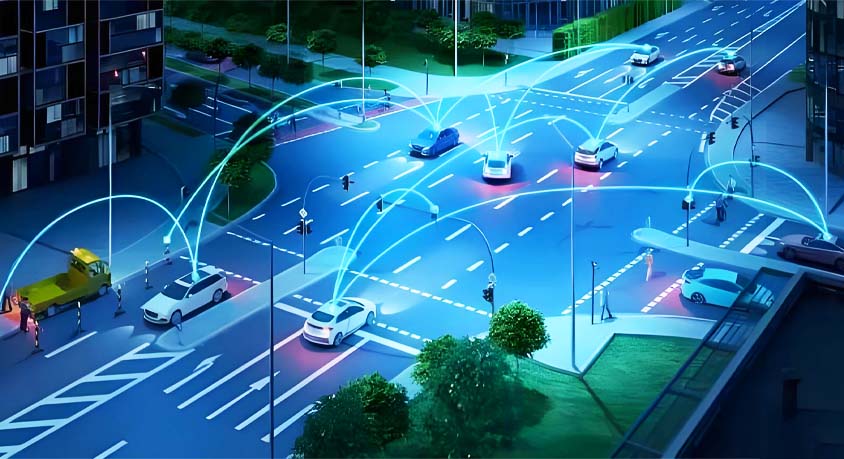
Now reprogram the scenario. The bicycle has a tag. It is not transmitting video. It is not streaming anything. It is simply broadcasting its position via UWB, a protocol that measures distance with centimeter accuracy by timing radio pulses. The van is still there, blocking your view. But the streetlight above the intersection has a receiver. It picks up the bicycle's broadcast. It also picks up your car's broadcast. In 10 milliseconds, the roadside unit calculates the trajectories. It sees the intersection. It sees the occlusion. It sends a message to your dashboard: "Bicycle approaching from left, 50 meters, 8 seconds to intercept." Your car slows itself before you even turn your head.
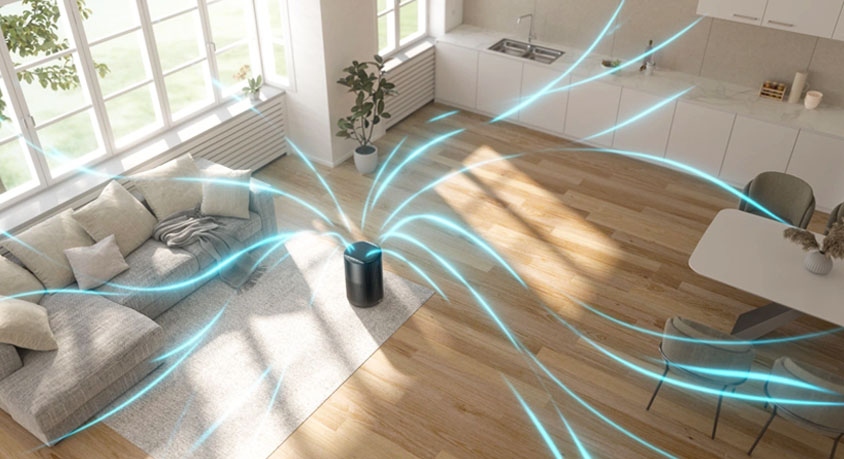
This is V2X with blind spot penetration. It is not magic. It is simply the replacement of line-of-sight with data relay. Your eyes require a straight line to the object. Radio does not. Radio bounces, bends, and passes through. When you add a network of fixed infrastructure, the radio signals become a web. If any node in that web sees the bicycle, every node in that web knows about the bicycle. The information propagates faster than the bicycle moves. The latency is measured in milliseconds, not in human reaction time.
The technology stack is specific. UWB gives the precise location. It is not GPS, which can drift by several meters and fails indoors or in urban canyons. UWB measures time of flight. A pulse leaves the tag, hits three receivers, and the system triangulates your position to within 10 centimeters. That is the difference between "a bicycle is near the intersection" and "a bicycle will enter the crosswalk in 2.3 seconds." The second statement is actionable. The first is just noise.
The communication layer is 5G-V2X, or its dedicated short-range cousin. It is designed for one thing: moving packets between moving objects with guaranteed low latency. When a pedestrian with a connected phone steps off the curb, the phone talks to the car. When a construction worker holds up a stop sign equipped with a transmitter, the sign talks to the trucks. When a child runs into the street after a ball, the tag in the shoe screams. The car hears the scream before the driver hears the screech.
This changes the geometry of safety. In the old model, safety was about passive features: airbags, crumple zones, antilock brakes. They reduce damage after the event. In the connected model, safety becomes predictive. The event is avoided because the information arrived early. The car does not need to see the bicycle. It just needs to know where the bicycle is. The knowledge comes from the network, not the retina.
For cyclists and pedestrians, this means carrying a five-dollar tag. It is not a phone. It is not a tracker. It is a broadcaster. It runs for a year on a coin cell because it only transmits when it moves, or when it is polled by an approaching vehicle. It has no screen, no interface, no subscription. It just says, "I am here. I am a person. Do not hit me." The car listens. The infrastructure relays. The accident is archived in the "almost happened" file instead of the police report.
The broader implication is the inversion of responsibility. Today, the driver is liable because the driver is the only sensor. Tomorrow, the driver is just a passenger in a system that senses collectively. If a child runs out from behind a truck, and the car does not stop, the question is not "did the driver look?" The question is "did the infrastructure see?" If the child had a tag, and the roadside unit received it, and the car received the alert, the system failed. If the child had no tag, the physics remain unforgiving. The choice is binary: equip the vulnerable, or accept the casualties.
This is not a distant concept. Pilot programs in Europe and Asia are equipping school zones with UWB networks. Bicycle-sharing fleets are integrating transmitters. Automakers are including V2X receivers as standard equipment. The penetration is low now. But the logic is viral. A single car that can see around corners saves one life, and the cost of the tag becomes irrelevant. The blind spot is not a feature of the road. It is a failure of the network. And networks can be fixed.
Disclaimer: Mention of any brand or trademark is for identification only and does not imply partnership or endorsement