You have a drawer in your kitchen. It is filled with dead batteries. AAA, AA, coin cells. You keep meaning to recycle them. You never do. Every smart device in your home is a parasite. It feeds on these chemical capsules, and when they are empty, you throw the parasite away and buy a new one. This is the dirty economics of the Internet of Things. The sensor is cheap. The battery is cheap. The labor to change that battery, across a billion devices, is not cheap. It is an ecological and operational disaster.
Now imagine a sensor the size of a grain of rice. It has no battery. It has no wire. It is printed on flexible plastic and costs about ten cents to manufacture. You stick it on a shipping box. It will report the location and temperature of that box for the next ten years. It will never need a charge. It will never be touched again. When the box is recycled, the sensor goes with it, silent, harmless, and dead only because the box no longer exists. This is not science fiction. This is passive IoT.
The physics are elegant. The chip does not generate energy. It harvests it. It is an energy vampire, but a polite one. It feeds on the ambient electromagnetic radiation that already floods our world. Wi-Fi signals bounce off your walls. 5G towers blanket the city. Radio waves from FM stations pass through your body right now. This is energy. It is just too diffuse to light a bulb or charge a phone. But for a microchip that needs a few microwatts to transmit a single bit of data, it is a feast.
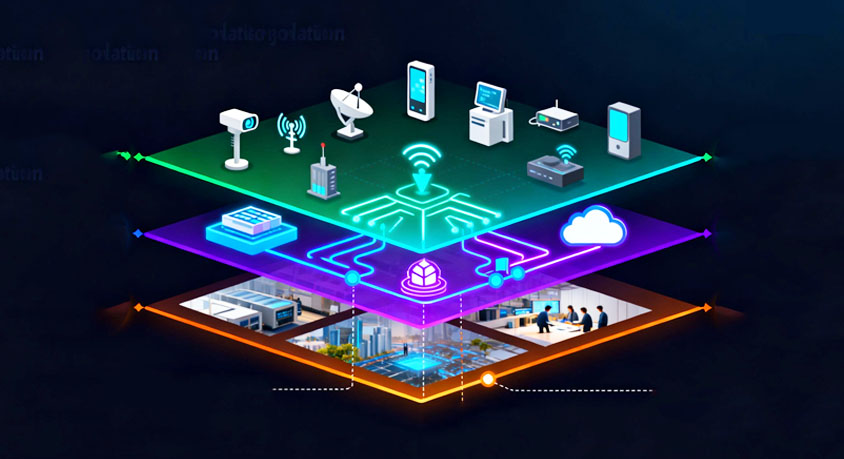
The technology is called ambient backscatter. Think of it as a mirror for radio waves. A conventional transmitter creates its own signal, burning power. A passive IoT tag does not create. It reflects. It takes the Wi-Fi signal already in the air, modulates it by changing its reflectivity, and sends back a tiny, coded flicker. That flicker contains data: "Package 447, temperature 22 degrees, location 34.05, -118.25." The reader, a nearby gateway, decodes the flicker. The tag has communicated without ever turning on a transmitter. It has no battery because it never truly transmits. It just borrows.
This is the difference between shouting and holding up a sign. Shouting requires lungs. Holding a sign requires only paper. The tag holds up a sign to passing radio waves. It says, "Here is my serial number." The wave carries that message to the reader. The energy to move the message comes from the original wave, not the tag. The tag is just the messenger.
The implications for logistics are absolute. Today, we scan barcodes or RFID tags at checkpoints. We know a package left the warehouse and arrived at the truck. We do not know what happened in between. Passive IoT sensors, powered by the RF energy from the truck's own Wi-Fi router, can report continuously. They can monitor cold chain integrity for pharmaceuticals from factory to pharmacy, with no battery to die in the middle of the Sahara. They can be embedded in concrete to report curing status, then left forever. They can be woven into clothing to monitor patient movement, then washed, indefinitely.
The cost structure inverts the economics of tracking. A battery-powered tracker costs five to twenty dollars. You only put it on assets worth tracking. A passive tag costs cents. You put it on everything. You track the cardboard box, not just the container. You track the individual pill bottle, not just the pallet. You track the library book, the luggage tag, the produce crate. The data becomes granular because the cost of granularity approaches zero.
The environmental argument is even simpler. A billion IoT devices, each with a disposable battery, creates a billion battery disposal problems. Lithium mining, chemical leakage, replacement labor. Passive IoT devices are printed circuits on biodegradable substrate. They have nothing to leak. They have nothing to replace. They sit on a package for its useful life and then disappear. The energy to run them was always there, ambient, free, and otherwise wasted.
Disclaimer: Mention of any brand or trademark is for identification only and does not imply partnership or endorsement