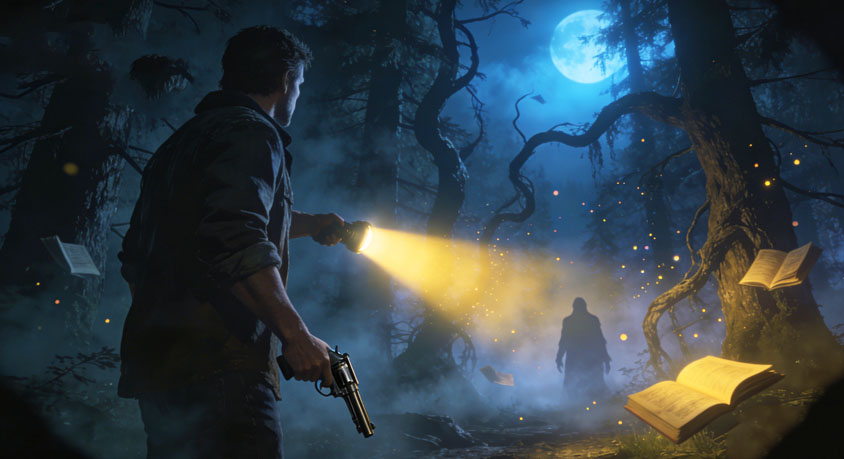
Let's be clear about what you're signing up for with Alan Wake 2. This is not a game you simply play. This is a game you move into. You furnish its rooms with theories, you wallpaper its halls with Reddit threads, and you spend months arguing with your new roommates—a global community of equally baffled and obsessed players—about the meaning of the cryptic graffiti in the shared bathroom. The accolades are deserved; it's a visual and auditory feast, a surrealist nightmare painted with the budget of a small film studio. But the real genius, and the source of that glorious, year-long online headache, isn't in the answers it gives. It's in the profoundly specific, meticulously crafted quality of the questions it leaves festering in your brain at 3 AM. You won't just need a wiki to understand it; you'll need a support group. A book club that’s slowly morphed into a collective, caffeine-fueled psychosis.
The game operates on a simple, devious premise: what if a writer's metaphors became literal, but the story got stuck in a feedback loop with reality, and also there's a musical number? You play two perspectives: Saga Anderson, an FBI agent investigating murders in the creepy town of Bright Falls, and Alan Wake himself, still trapped in the Dark Place—a nightmarish version of New York City that is equal parts haunted metropolis and writer's block made manifest. Saga's side is a police procedural written by David Lynch, where you solve cases by physically arranging clues on a Mind Place bulletin board inside her own head. Alan's side is a desperate, meta-textual scramble to rewrite reality itself, often by finding plot points in the environment and literally changing the scene around you. The game doesn't blur the line between reality and fiction; it pulverizes that line, mixes the dust with nightmare fuel, and asks you to sniff it and tell it what you see. It’s less a narrative and more an ongoing, interactive nervous breakdown.
This is where the "wiki" becomes not a cheat sheet, but a necessary organ. The story is a dense, intertextual web that pulls from thirteen years of Remedy's shared universe—Alan Wake 1's DLC, Control and its expansions, even live-action shorts and in-universe talk shows. A character's offhand comment might be the key to a document you find four hours later. A symbol on a poster in the Dark Place might mirror a cult logo from a case file in Bright Falls. The game expects you to be a detective not just within the case board, but across the entire fabric of its mythology. It’s a narrative designed for the age of second screens and collective investigation. Playing it alone, in a vacuum, feels like trying to solve a conspiracy theory with only half the newspaper clippings. The Reddit forums aren't supplemental; they're essentially the game's director's commentary, crowdsourced in real-time.
But here’s the warm, human truth beneath all the brain-melting complexity: the confusion is the point. The game isn't failing to communicate; it's perfectly communicating the experience of its protagonists. You feel Saga's analytical frustration as clues contradict each other. You feel Alan's desperate, looping madness as every attempt to write an escape just digs him deeper. The "need for a wiki" mirrors our own human need to make sense of chaos, to gather with others and say, "Wait, what did you think that meant?" The game’s deepest horror isn't the Taken monsters in the woods; it's the terror of a story without a coherent ending, a mystery that might not have a solution. And its deepest comfort is the shared, communal act of trying to find one anyway.
So, is it a beautiful mess? Absolutely. But it's a mess in the way a genius's desk is a mess—every scrawled note, every crossed-out line, every strange artifact is part of a brilliant, interconnected system that only makes sense to the person living inside it. Alan Wake 2 invites you to live inside that desk for 20 hours. You’ll leave with your hair grey, your notes app full of wild theories, and a profound admiration for a game brave enough to believe its audience would love the beautiful, terrifying process of getting utterly, delightfully lost.
Disclaimer: Mention of any brand or trademark is for identification only and does not imply partnership or endorsement