
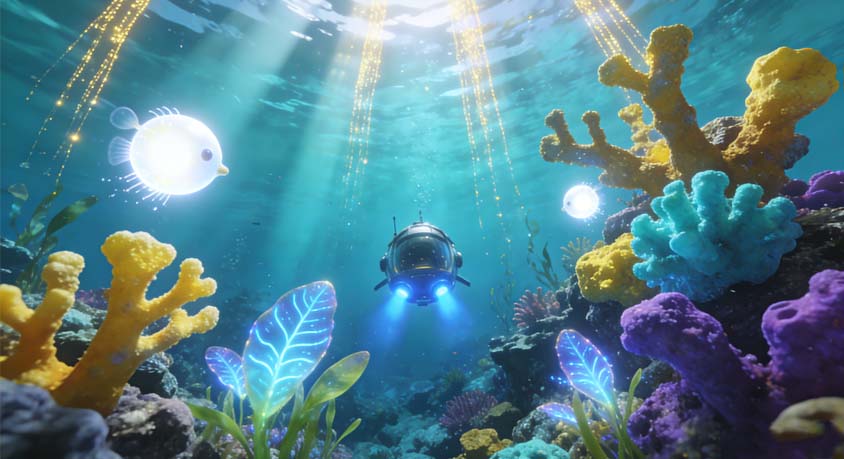
At first glance, Subnautica looks like a chill underwater vacation sim: colorful coral reefs, glowing fish, and the gentle hum of your oxygen tank as you float through alien waters. Then you hear it—the low, rumbling growl from the dark trench just beyond your flashlight’s reach—and suddenly, that “vacation” feels like a horror movie where you’re the main character. This is Subnautica’s dirty little secret: it’s not a peaceful explorer game. It’s a cosmic horror story disguised as a snorkeling trip, and it’s brilliant at making you simultaneously want to surface and dive deeper. So why do we keep hitting that “descend” button even when our hearts are racing? Because Subnautica turns fear into fuel—and curiosity into the ultimate survival tool.
Let’s talk about the ocean itself: beautiful, vast, and out to kill you. Every glowing plant hides a stinging tentacle, every empty cave could house a Leviathan (a sea monster so big it makes sharks look like goldfish), and every minute you spend underwater is a countdown to running out of oxygen. Subnautica doesn’t rely on jump scares to terrify you; it uses the unknown. You’ll find yourself hovering at 200 meters, flashlight trembling, wondering if that shadow is a school of fish or something that wants to swallow your submarine whole. And yet, you’ll inch forward anyway—because that shadow might be hiding a new resource, a lost blueprint, or a clue about why you’re stranded on this alien planet. The game weaponizes your own curiosity, turning “what’s over there?” into a question that could save or end you.
Then there’s the resource management that ties survival to exploration. You can’t just dive blindly; you need to stock up on oxygen tanks, water filters, and emergency rations before venturing into the deep. A single mistake—staying too long to collect a rare mineral, or panicking and swimming the wrong way—leads to a slow, claustrophobic death by drowning or starvation. But here’s the kicker: every resource you gather isn’t just for staying alive. It’s for building a base, your tiny slice of safety in the chaos. There’s something deeply satisfying about crafting a sea-glass window for your underwater pod, then watching glowing fish swim by while you cook alien kelp stew—even as you hear a Leviathan roar outside. That contrast between the warmth of your base and the cold, dangerous ocean beyond is what keeps you hooked: you build to survive, but you survive to explore.
Subnautica’s magic is how it balances beauty and terror. For every terrifying encounter with a Reaper Leviathan, there’s a moment of awe as you discover a field of bioluminescent mushrooms or a hidden underwater cave filled with ancient alien technology. The game doesn’t make the ocean feel evil—it makes it feel alive, and that’s scarier. This isn’t a monster closet horror game; it’s a game about being small in a world that doesn’t care about you. And yet, you adapt. You craft better submarines, you learn to avoid Leviathan territories, you turn the ocean’s dangers into obstacles to overcome. By the time you’re building a fully functional underwater base with a garden and a vehicle bay, you’re not just surviving—you’re thriving in a world that tried to kill you.
In a genre full of games that rely on gore or cheap frights, Subnautica stands out by making fear feel personal. It taps into that primal human fear of the deep sea while feeding our desire to explore the unknown. You’ll finish a play session with your hands shaking, vowing never to dive below 300 meters again—then boot up the game an hour later to check that one last cave. Because Subnautica doesn’t just let you explore an alien ocean; it makes you want to conquer it, one terrified dive at a time.
Disclaimer: Mention of any brand or trademark is for identification only and does not imply partnership or endorsement