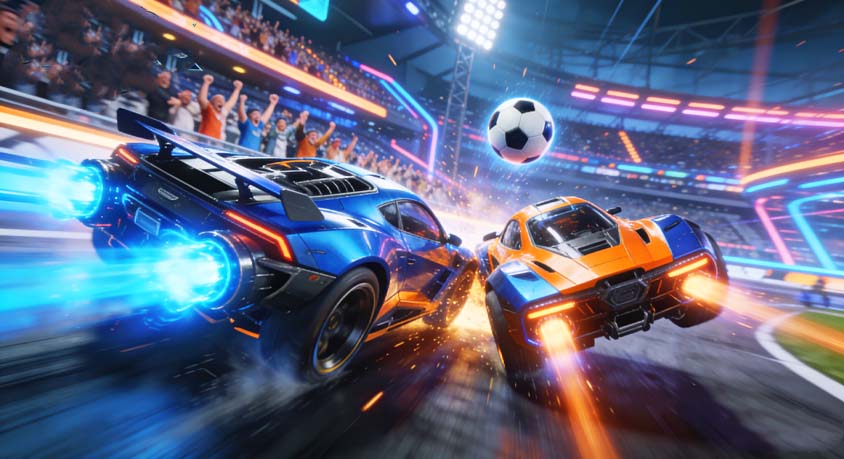
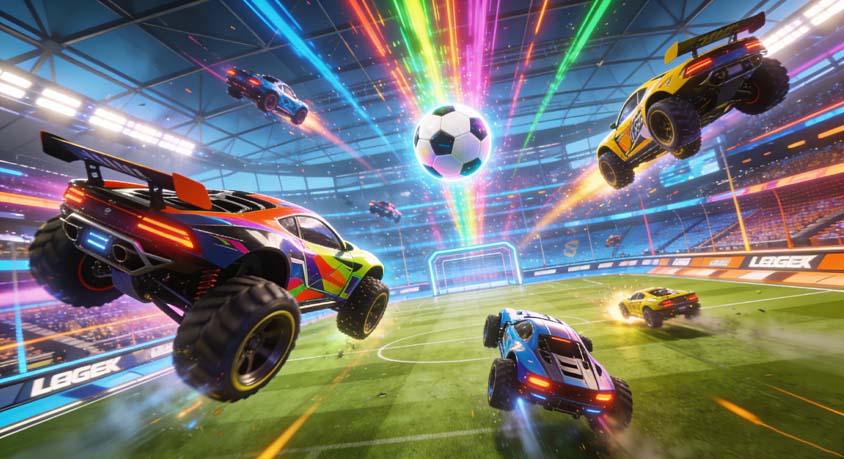
Let’s be real—on paper, Rocket League sounds like a drunk game dev’s fever dream: “What if we crossed soccer with race cars… and made it a competitive esport?” Ten years later, it’s not just still here—it’s thriving, with millions of players logging hours to chase that perfect aerial goal or last-second save. The question isn’t “why did this work?” but “why hasn’t any game copied it successfully?” Because Rocket League’s magic isn’t just the absurd premise—it’s the invisible perfection of its mechanics, turning a “silly” idea into a game that’s easy to pick up, impossible to master, and endlessly satisfying. You don’t play Rocket League for 10 minutes; you play “one more game” until 2 a.m., wondering how a ball and a car got you hooked this hard.
The genius starts with the physics—tight, responsive, and just chaotic enough to feel unpredictable. This isn’t some floaty arcade racer; every boost, drift, and jump feels weighted, like your car has actual heft. Hit the ball dead-center with a boost, and it rockets across the field with a satisfying thud. Misjudge the angle, and you’ll go careening into the wall, watching in horror as the opposing team scores. But here’s the kicker: even the mistakes feel fun. You’ll laugh as your teammate slams into you mid-chase, or cheer when a lucky bounce turns your blunder into a goal. The physics reward skill but don’t punish experimentation—you can learn the basics in five minutes, but mastering the art of “air dribbling” (controlling the ball mid-flight with your car) could take months. It’s a game that meets you where you are, whether you’re a casual player just messing around or a tryhard chasing rank.
Then there’s the “easy to learn, hard to master” loop that’s catnip for gamers. Anyone can jump in, hit the ball, and score a goal—within your first match, you’ll feel like a pro. But as you play more, you start to see the layers: the subtle positioning that lets you cut off passes, the timing of boosts to stay in the action, the way a well-timed flip can redirect the ball into the net. Suddenly, you’re not just driving—you’re strategizing. You’ll find yourself practicing aerial shots in free play, replaying clips of your best saves, and yelling at your screen when a teammate ignores the open net to show off a fancy trick. Rocket League doesn’t just let you get better—it makes you want to get better, because every small improvement feels like a victory. Even after 100 hours, you’ll still have “wait, I can do that?” moments that keep the game fresh.
And let’s not sleep on the team dynamic—chaotic, cooperative, and sometimes infuriating (in the best way). This isn’t a solo game masquerading as a team sport; you need to communicate (even if it’s just spamming “Take the shot!” or “My bad!”), cover your teammates, and adapt to their playstyle. A perfect pass from a teammate feels just as good as scoring yourself, and a last-second save that bails out your squad? That’s the stuff of gaming legend. Rocket League turns strangers into temporary allies, bonding over shared triumphs and hilarious failures. It’s the kind of game where you’ll add a random teammate as a friend just because they nailed a cross that set up your winning goal.
In a world of games with bloated open worlds, microtransactions, and convoluted stories, Rocket League is a breath of fresh air—simple, focused, and endlessly replayable. It doesn’t need cutscenes or lore; it just needs a ball, a car, and a goal. It’s a game that proves you don’t need a huge budget or a groundbreaking idea to create something timeless—you just need to nail the fundamentals. Whether you’re playing with friends on the couch or competing in ranked matches online, Rocket League delivers that pure, unadulterated joy of gaming: the thrill of improvement, the rush of victory, and the laughter of shared chaos.
Disclaimer: Mention of any brand or trademark is for identification only and does not imply partnership or endorsement