
Open your refrigerator. Look past the yogurt and the leftovers to the back corner. There is something there you bought, forgot, and will eventually throw away. You are not alone in this. The United States wastes roughly 40 percent of its food supply, a figure that has become so familiar it no longer shocks. What is less often discussed is how much of that waste is driven not by consumer carelessness but by structural failures in packaging—the wrapper that cannot be recycled, the label that confuses, the date that means nothing. The food rots because the system around it was designed to expire.
Two distinct technological responses have emerged to address this problem, one focused on replacing packaging materials entirely and the other on making packaging intelligent enough to tell you what is actually happening inside it. They operate at different scales but converge on the same insight: the gap between food that is safe and food that is thrown away is a gap in information, and information can be embedded in materials.
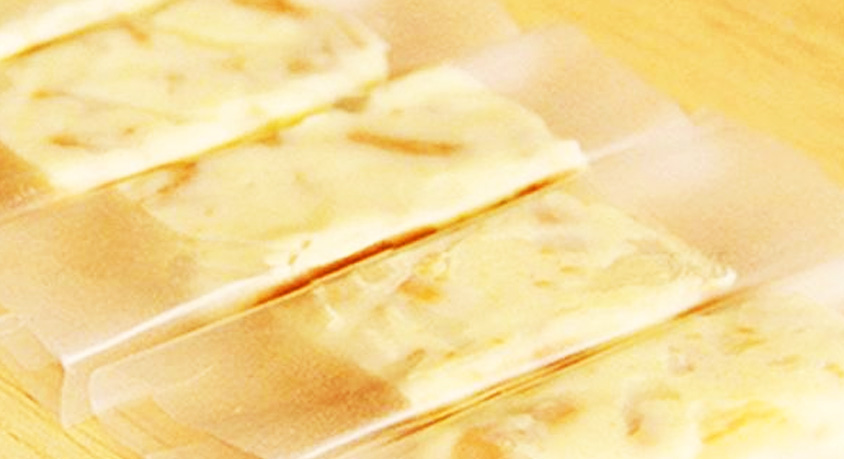
The first approach is edible packaging. This is not a novelty item or a stunt. It is a category of materials derived from substances that are already food-adjacent—seaweed, milk protein, starches, plant cellulose—engineered into films, coatings, and containers that perform the same functions as plastic but dissolve, biodegrade, or become part of the meal. A seaweed-based film can wrap a sandwich, hold moisture, and be eaten along with the crust. A milk-protein coating can extend the shelf life of cheese by slowing oxidation and then be consumed with the product. A water-soluble pouch can hold a single serving of oats or soup mix and disappear entirely in hot water.
The engineering challenge here is not simply making something edible. It is making something that performs. Plastic packaging works because it is cheap, durable, and impermeable. Replacing it requires matching those properties while adding a new one—disappearance—that plastic does not have. Seaweed films, for example, are grown rather than synthesized. They require no petroleum, no chemical processing, and they degrade in weeks rather than centuries. But they also absorb moisture, which makes them unsuitable for products that need to stay dry for months. The current generation of edible packaging is targeted at short-shelf-life applications: fresh produce, baked goods, single-serve portions. It is not replacing the plastic clamshell around your blueberries. It is replacing the plastic wrapper around your granola bar.
The second approach is smarter packaging. This takes the form of sensors and indicators integrated into the packaging itself, providing real-time information about the condition of the food inside. The simplest version is the time-temperature indicator, a small label that changes color when a product has been exposed to temperatures that accelerate spoilage. More sophisticated versions use printed electronics to detect specific gases released by bacterial growth, or electrochemical sensors that measure pH changes in the food itself. The data can be read by a smartphone or transmitted wirelessly, creating a continuous record of freshness that replaces the blunt instrument of the sell-by date.
What makes this more than an incremental improvement is the nature of the information it provides. Current expiration dates are estimates based on worst-case scenarios. They assume improper storage, temperature abuse, and maximum liability. A package of chicken may be perfectly safe ten days after its printed date, but it is thrown away because the date has passed. An intelligent label that reads “safe to eat” or “discard” eliminates the guesswork. It shifts decision-making from a static prediction to a dynamic measurement. This is not just a convenience. It is a structural reduction in waste at the household level, where the majority of food loss occurs.
There is a third layer here that connects these two developments, and it is the question of what we mean by waste. A plastic wrapper that protects a cucumber from damage for two weeks but takes five hundred years to decompose is not solving a waste problem. It is deferring it. Edible packaging and intelligent labels both address the deferred waste problem, but from different angles. One removes the packaging from the waste stream entirely. The other reduces the food waste by making the packaging a source of information rather than a source of confusion.
The limitations are worth noting. Edible packaging is more expensive than plastic, though the gap is narrowing as production scales. It is also less durable, which limits its applications. Intelligent labels add cost to packaging, and the sensors themselves become waste once the product is consumed. Neither approach addresses the deeper structural issue: a food system that produces more than it can distribute, that treats cheap food as disposable, that externalizes environmental costs across supply chains. These are not problems that packaging can solve.
But what packaging can do is reshape the decision-making environment for consumers and retailers. If the wrapper can be eaten, the decision to discard it disappears. If the label can tell you the food is still safe, the decision to discard based on a date becomes irrational. These are small shifts, but they operate at enormous scale. The average American household throws away about 30 percent of the food it buys. Most of that is not rotten. It is simply past a date or wrapped in something that cannot be repurposed. Intercepting that waste at the point of disposal is not a solution to the systemic problems of agriculture and distribution. But it is a solution to the specific problem of the refrigerator, the pantry, the lunchbox.
The technology is moving faster than the habits it aims to change. Seaweed films are already in use in parts of Asia and Europe. Milk-protein coatings are being tested in commercial dairies. Printed freshness sensors are appearing on high-value products like salmon and berries. The question is not whether these materials will become cheaper and more capable. They will. The question is whether the infrastructure—the supply chains, the retail practices, the household habits—will adapt to what they make possible. A wrapper you can eat does nothing if it is thrown away. A label that tells you the truth is useless if you ignore it. The shift is material, but it is also cognitive. And that is always the slower part.
Disclaimer: Mention of any brand or trademark is for identification only and does not imply partnership or endorsement