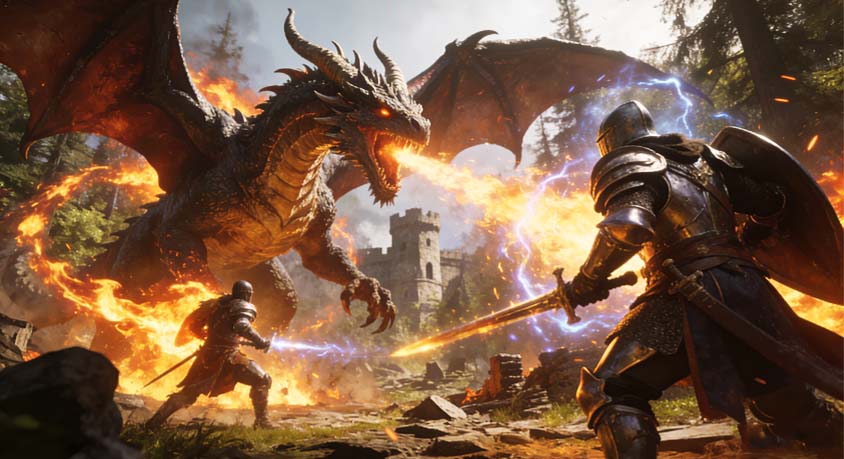
Let me tell you about the most humiliating, terrifying, and exhilarating fifteen minutes I've spent in a video game this year. I'm fifteen minutes into Dragon's Dogma 2, fresh out of the character creator where I spent an hour perfecting my arisen's jawline. I'm feeling good. I'm feeling powerful. I walk out of the first village, see a curious cave entrance on a hillside, and think, "Ooh, loot." I venture inside. Something huge moves in the darkness. My lantern flickers. I see a massive, scaled leg. Then another. Then a head the size of my entire body turns toward me, and a single, glowing eye fixes me with the disinterested gaze of an apex predator that has just spotted an amusingly crunchy snack. I do not draw my sword. I do not cast a spell. I turn around and sprint for the exit like a man being chased by every bad decision he's ever made. My pawns, my loyal companions, are screaming behind me. One of them doesn't make it. I emerge into the sunlight, gasping, heart pounding, and utterly, completely hooked. This game isn't just an RPG. It's a masterclass in the forgotten art of existential terror, and it has reminded millions of players what it actually feels like to be small in a big, uncaring world.
We need to talk about what modern open-world games have done to our brains. We've been conditioned by years of gentle, accommodating design. You know the formula: you enter a zone, the game quietly scales enemies to your level, and you're never truly out of your depth. The world is a theme park, and you're the VIP guest who gets to ride every ride without waiting in line. Dragon's Dogma 2 looks at that philosophy and says, "No." In this world, a drake is a drake. It doesn't care that you're level 3. It doesn't scale its fire breath to your hit points. If you wander into its territory, you will die. Quickly. Probably painfully. This isn't "difficulty" in the Dark Souls sense of learning patterns and mastering mechanics. This is ecological reality. You are an animal in a food chain, and right now, you're plankton.
This creates a completely different relationship with the world. Exploration stops being about ticking boxes on a map and becomes a genuine act of courage. Every ridge you crest, every forest you enter, carries the real possibility of sudden, catastrophic death. You learn to read the environment. You see massive footprints and think, "Nope." You hear a distant roar and change direction. You travel at night with genuine anxiety, knowing that darkness actually means something here, that things are hunting. The game transforms the open world from a checklist into a living, breathing, hungry ecosystem. And when you finally, after hours of careful progress and terrified running, manage to kill that drake that chased you out of the cave? The satisfaction is incomparable. You earned that victory. The game didn't give it to you.
This design philosophy also transforms your pawns from simple AI companions into genuine survival assets. They're not just there to carry your loot and make combat slightly easier. They're your early warning system. They'll spot enemies before you do. They'll shout warnings about ambushes. They'll remember that this cave has a cyclops and advise against entering. They become, in a very real sense, your survival partners. You care about them not because the game tells you to, but because losing one in a panicked retreat from a griffin feels like a genuine failure. You dragged them into danger. You got them killed. The bond is earned through shared terror, not scripted cutscenes.
So, is Dragon's Dogma 2 a game about being weak? Not exactly. It's a game about becoming strong. It understands that power is meaningless without context. You can't feel like a hero if you never faced insurmountable odds. You can't feel like you've conquered the world if the world never fought back. By forcing you to run, to hide, to strategize, to survive, the game makes every hard-won victory resonate. It's not just a game; it's a reminder that the best adventures aren't the ones where you're invincible. They're the ones where you spend the first twenty hours running for your life, and then, finally, turn around and fight.
Disclaimer: Mention of any brand or trademark is for identification only and does not imply partnership or endorsement