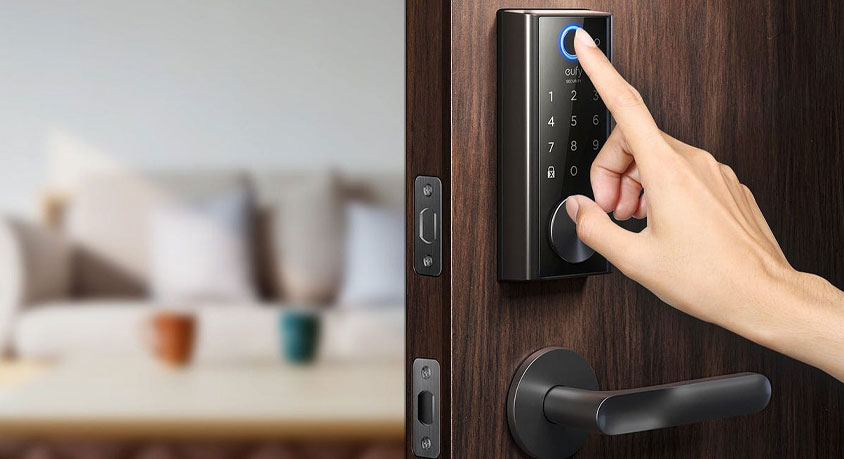
Smart door locks have become a fairly mature category in the realm of smart home products. People choose smart door locks to replace traditional door locks mainly to get a better unlocking experience. For smart door locks, good use and security are the core user needs. With more and more brands participating in the competition, the smart door lock market continues to intensify, prompting brands to continuously improve and update their products.
The unlocking methods of smart door locks are becoming more and more diversified, from the traditional physical keys and passwords to fingerprints, NFC, and nowadays 3D face, and even some smart door locks have started to try vein unlocking, which is a new type of biometric identification method.
Vein unlocking on smart door locks uses human veins as a unique bio-information credential. In practice, the device emits infrared light to irradiate the human body, and the hemoglobin in the blood absorbs the infrared light thus forming a vein image. The device compares the collected vein data with the recorded image through an algorithm to determine whether the verification is passed. Currently, there are two main types of vein unlocking technology in smart door locks: finger vein and palm vein. Some products are equipped with a finger vein recognition device with a small area behind the handle for detecting single finger vein information; others use palm vein unlocking solutions with a larger recognition area and a longer distance. However, which one is more convenient depends on individual usage habits.
With fingerprint identification technology widely used, why introduce vein unlocking technology in door locks? Fingerprint technology has obvious limitations in the application of smart door locks, for example, it is not friendly to the elderly and children, the elderly fingerprints wear and tear, children's fingerprints are lighter easily lead to recognition difficulties, and ordinary people's fingers sweat or peeling skin may also affect the recognition. In contrast, human vein image has uniqueness, and as a feature of the body can circumvent the wear and tear of fingerprints, both of which are guaranteed in terms of security. However, vein technology is not perfect, for example, in cold temperatures, blood vessel constriction may lead to changes in subtle features, thus affecting the identification, which is more likely to occur in northern regions. To solve this problem, users can enter multiple sets of vein information, while manufacturers need to improve and upgrade the vein algorithm. Due to the relatively small number of application scenarios of vein technology, the data used for algorithm training is not rich enough, and its optimization needs more time.
Nowadays, almost every smart door lock has a variety of unlocking methods, in addition to vein unlocking, there are fingerprints, 3D face, iris and other biometrics, as well as the traditional physical key to unlock the door mechanically, the digital code to unlock the door, as well as remote unlocking, NFC unlocking, Bluetooth unlocking, etc. These methods have their own advantages and disadvantages, for example, vein technology is not enough data for algorithm training. These methods have their own advantages and disadvantages, such as 3D face unlocking speed, high security, but power consumption, and may be difficult to recognize when the user wears a hat, mask; NFC, Bluetooth unlocking through the cell phone, Bluetooth may not be connected or cell phone does not support problems. Under the current technical conditions, mainstream smart door lock manufacturers generally support a variety of unlocking methods, especially a variety of biometric methods.
Disclaimer: Mention of any brand or trademark is for identification only and does not imply partnership or endorsement