The American construction industry has a problem that no amount of recruiting or wage increases seems to solve. The workforce is aging. The average age of a construction worker is now over forty. Fewer young people enter the trades than leave them each year. The gap between the number of housing units needed and the number being built is partly a materials problem and partly a permitting problem, but at its core it is a labor problem. There are not enough people to do the work. And the work itself—bricklaying, drywall installation, welding, rebar tying—has not fundamentally changed in generations. A mason today works much as a mason worked fifty years ago.
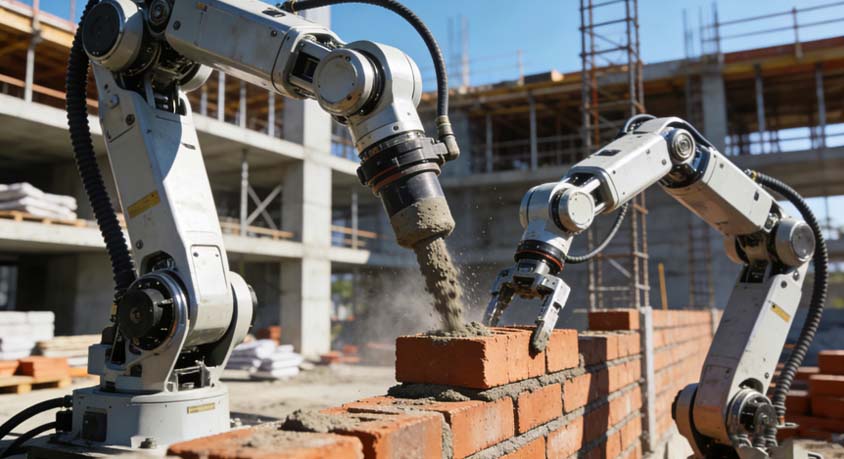
A different set of workers has been appearing on job sites, though they do not look like the workers who have been there before. They are machines. Not the heavy equipment of earthmoving and lifting—excavators, cranes, bulldozers—that have been part of construction for decades. These are new. A bricklaying robot that sets blocks faster than a team of masons, guided by lasers and fed by a conveyor system that never runs out of material. A welding robot that runs on tracks along steel beams, depositing beads with a consistency no human welder can match hour after hour. A rebar-tying robot that walks along forms, twisting wire ties at a rate that would exhaust a crew in a day. They do not take lunch. They do not need breaks. They do not file workers’ compensation claims.
The machines that have entered construction sites in the past decade are not general-purpose humanoids. They are highly specialized. Each is designed for a single task that is repetitive, physically demanding, and difficult to staff. The bricklaying robot does not pour concrete or install windows. It lays block. That is all. But it does it at a speed and consistency that changes the economics of masonry. A wall that would take a crew of masons a week can be laid in two days. The cost per block falls. The schedule shortens. The project becomes feasible in a labor market where finding a single qualified mason is difficult and finding a crew is nearly impossible.
The welding robot operates on a similar logic. Structural steel welding requires certification, steady hands, and working conditions that are often uncomfortable—high off the ground, in tight spaces, exposed to weather. The number of certified welders entering the workforce has been declining for years. The robot does not replace the welder entirely. It takes over the long, repetitive passes that require endurance rather than judgment. The welder operates the machine, moves it into position, and inspects the finished work. The job changes from performing the weld to managing the machine that performs it. The demand for skill does not disappear. It shifts.
What is striking about these machines is not that they are replacing human workers. It is that they are arriving in an industry that cannot find enough human workers to fill the jobs that exist. The Bureau of Labor Statistics projects hundreds of thousands of construction job openings annually for the foreseeable future. There are not enough people entering the trades to fill them. The machines are not displacing workers. They are filling roles that would otherwise go unfilled, allowing projects to proceed that would otherwise be delayed or canceled.
The question of displacement is more complex than the simple substitution narrative suggests. A bricklaying robot eliminates the need for some masons. But it creates demand for operators, for maintenance technicians, for the software engineers who write the code that guides the machine along its path. The net effect on employment is not obviously negative. The more immediate effect is on the composition of the workforce. The workers who remain on site are doing different work. They are not laying brick by brick. They are managing the machine that lays bricks. They are not tying rebar by hand. They are walking alongside the robot that ties it, checking its work, resetting it when it jams.
There is a longer historical pattern here that is worth recalling. Mechanization in agriculture displaced millions of farmworkers in the early twentieth century. It also made food cheaper, freed labor for industrial work, and eventually created jobs in the equipment manufacturing and service sectors that did not exist before. The transition was painful for the workers displaced. It was not an unqualified good. But it was also not simply a loss. The pattern in construction may follow a similar arc. The difference is that the labor shortage is driving the mechanization rather than the other way around. The machines are coming because the workers are not.
The machines themselves are becoming more capable. Early versions required extensive setup and constant supervision. Current versions use onboard sensors to adjust to variations in materials and site conditions. A bricklaying robot now scans the wall as it builds, comparing the actual position of each block to the digital model, correcting for drift automatically. A welding robot monitors arc stability and adjusts parameters in real time. The operator’s role is becoming less about direct control and more about oversight. This is not a trivial distinction. It changes the skill set required. The worker who thrives in this environment is not necessarily the one who is best at laying brick. It is the one who can read a tablet, interpret a data feed, and intervene when the machine deviates from the plan.
There is a tendency to frame these developments in terms of loss—jobs lost, skills devalued, a way of work ending. There is loss in that framing. But there is also gain. The gains are less visible because they are distributed: lower construction costs, faster project completion, fewer workplace injuries, the possibility of building at a scale that labor shortages would otherwise prevent. The worker who operates a bricklaying robot does not suffer the chronic back and knee injuries that come from a lifetime of masonry. The welder who manages a welding robot does not breathe the fumes or burn their forearms on hot metal. The gains are real. They are just harder to see than the machine itself.
Disclaimer: Mention of any brand or trademark is for identification only and does not imply partnership or endorsement